

What a Real Breach Means for Nonprofits and Behavioral Health Organizations in California
A staff member received a ZIP file through a work chat last month.
It looked like a routine screenshot from a customer. They opened it. Nothing seemed wrong. The day continued.
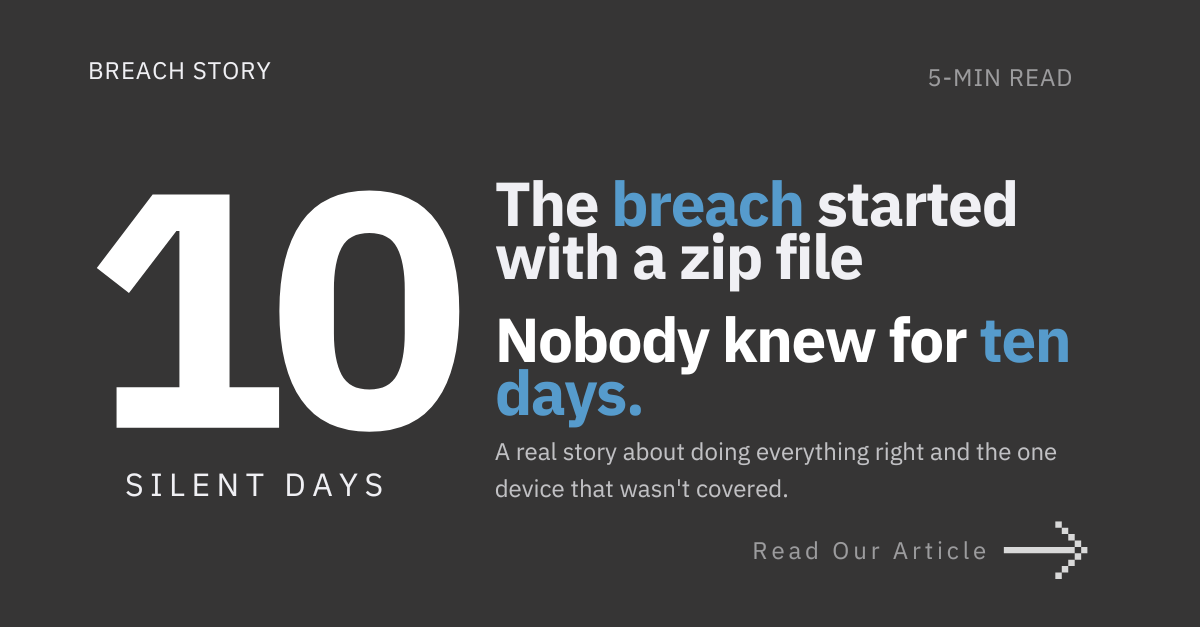
Ten days passed before anyone found out the organization had been breached.
They had a full IT team. Security tools. Dedicated staff. None of it mattered because nobody had looked at one laptop in three years.
If you lead a nonprofit or behavioral health organization in California, that story is worth sitting with.
What Happened
The attacker did not break through a firewall. They used the organization’s own customer support chat to send a file that looked completely harmless. A staff member opened it. Cybersecurity tools caught the attempt on one computer and shut it down within hours.
The team investigated, cleaned it up, and considered it handled.
What nobody checked was whether any other machines had been hit the same way. One had. A laptop that had been running for over three years, quietly doing its job, with no security software installed. Nobody knew it was unprotected. It had simply fallen off the list somewhere along the way.
For ten days, the attacker had access. They found out when a security researcher outside the organization noticed an unusual pattern and reported it. Not an internal alert. Not their own team. A stranger.
The organization’s own incident review said it directly: without that outside report, the breach might have continued even longer.
The Two Things That Made It Possible
Reading through the organization’s public investigation findings, two things stand out. Neither is exotic. Both exist in most nonprofits and behavioral health organizations.
A device nobody had checked in years.
It was not that someone decided to leave it unprotected. It had been set up, handed to a staff member, and then the daily work took over. Three years later, nobody had asked whether the protection was still running.
Think about the devices in your organization right now. The laptop a program coordinator takes home. The shared computer in the break room that has been there since 2020. The tablet a case manager uses to access your EHR in the field. When was the last time someone confirmed that every one of them is covered? This is exactly the kind of gap that managed IT is designed to close. Not reactively. Before anyone has to ask.
No one was watching quietly.
The organization’s monitoring caught what made noise. It did not catch what was silent. Ten days of quiet access went undetected because the gap was in a place nobody thought to look.
This is the harder question for most nonprofit leaders. Not whether you have security tools, but whether anyone is watching the things those tools might miss.
What It Actually Costs
The IBM Cost of a Data Breach Report 2025, based on a global study of 600 organizations across 17 industries conducted independently by Ponemon Institute, puts the average cost of a breach at $4.88 million. The same report found that 86% of organizations experienced operational disruption, and 65% had not fully recovered at the time of the study. The cost per compromised record averaged $160.
For a nonprofit in California, that number is not abstract. It is donor records. Client files. Case notes. PHI. Every record that was accessible during those ten days of quiet access is a record that may need to be reported, explained, and accounted for under HIPAA.
Beyond the financial cost, there is the program cost. Staff unable to work. Leadership time consumed by incident response instead of mission. Board conversations nobody planned for. Donor trust that takes years to rebuild.
The organizations that come through these situations are the ones that found out early. Days, not weeks. From their own team, not from a stranger.
Three Questions Your Organization Should Be Able to Answer
These are not IT questions. They are leadership questions. Any Executive Director or Program Director should be able to answer them.
Do you know every device your staff uses to access your organization’s systems? Email, donor records, client files, your EHR. Every device that touches any of these is part of your security perimeter. That includes personal laptops, shared machines, and anything used remotely. For behavioral health organizations, this includes every device that touches PHI, case management systems, and billing platforms.
If something were quietly wrong right now, how long before you would know? Not a system crash. Not a ransom message. Just someone reading files they should not have access to. How quickly would that surface?
Who is responsible for noticing before something becomes a crisis? In most nonprofits, the honest answer is that this job belongs to nobody in particular. IT support gets called when something breaks. That is a gap. And it is the gap that made ten days of undetected access possible.
You Do Not Have to Figure This Out Alone
At Advantage Microsystems, we have worked alongside nonprofits, community-based organizations, and behavioral health providers in California for 27 years. The organizations we work with do not spend time wondering whether their devices are covered or whether someone is watching for the quiet problems.
That is not because they have large IT budgets. It is because someone has made those questions their job.
If reading this made you realize you do not have a clear answer to one of those three questions, that is exactly where we start. We built a free five-minute awareness check specifically for nonprofit and behavioral health leaders in California. No technical background needed. No commitment. It shows you where things actually stand.
Take it here: Would You Know? Free IT Awareness Check
Questions About IT Security for Nonprofits
Most breaches start with something routine. A file a staff member opens, a device that has not been updated, or login credentials that were never removed after someone left. According to the IBM Cost of a Data Breach Report 2025, phishing was the top initial attack vector across organizations surveyed. For nonprofits, the risk grows with staff turnover and limited IT oversight, which leave gaps that can go unnoticed for months.
The IBM Cost of a Data Breach Report 2025, a global study of 600 organizations across 17 industries conducted independently by Ponemon Institute, puts the average at $4.88 million. For nonprofits, costs extend beyond the financial: HIPAA notification requirements, potential HHS enforcement, program disruption, and donor trust erosion all follow. The same report found 65% of organizations had not fully recovered at the time of reporting.
Most leaders do not know until someone looks. Devices get set up, staff turn over, and coverage gaps open quietly. At Advantage Microsystems, we offer a free IT awareness check designed specifically for nonprofits and behavioral health organizations in California. It takes five minutes and gives you a clear picture of where your organization stands. Take it at advantagemicro.net/would-you-know-breach-assessment.
A vendor responds when something breaks. An IT partner watches continuously, checks what most people never think to check, and tells you when something is off before it becomes a crisis. The organization in this story had a vendor relationship. The machine that went undetected for three years is what that looks like in practice. At Advantage Microsystems, our clients find out from us. Not from strangers.
CalAIM restructures how Medi-Cal delivers services, with significant technology implications for behavioral health organizations participating in Enhanced Care Management (ECM) and Community Supports. Requirements include EHR compatibility, data reporting, and coordination with managed care plans. Advantage Microsystems works directly with California behavioral health organizations on CalAIM readiness.
Advantage Microsystems is a California-based managed IT services provider with 27 years of experience working with nonprofits, CBOs, and behavioral health organizations. Start with the free five-minute awareness check at advantagemicro.net/would-you-know-breach-assessment. If you want to talk through what you find, you can book a 30-minute conversation directly with our team at https://link.advantagemicro.net/widget/booking/4MRlfCxpCeXCvqKBPDAR
Statistics sourced from the IBM Cost of a Data Breach Report 2025, based on a global study of 600 organizations conducted independently by Ponemon Institute across 17 industries in 16 countries and regions. IBM’s methodology examines direct and indirect costs including detection, containment, notification, and lost business.