

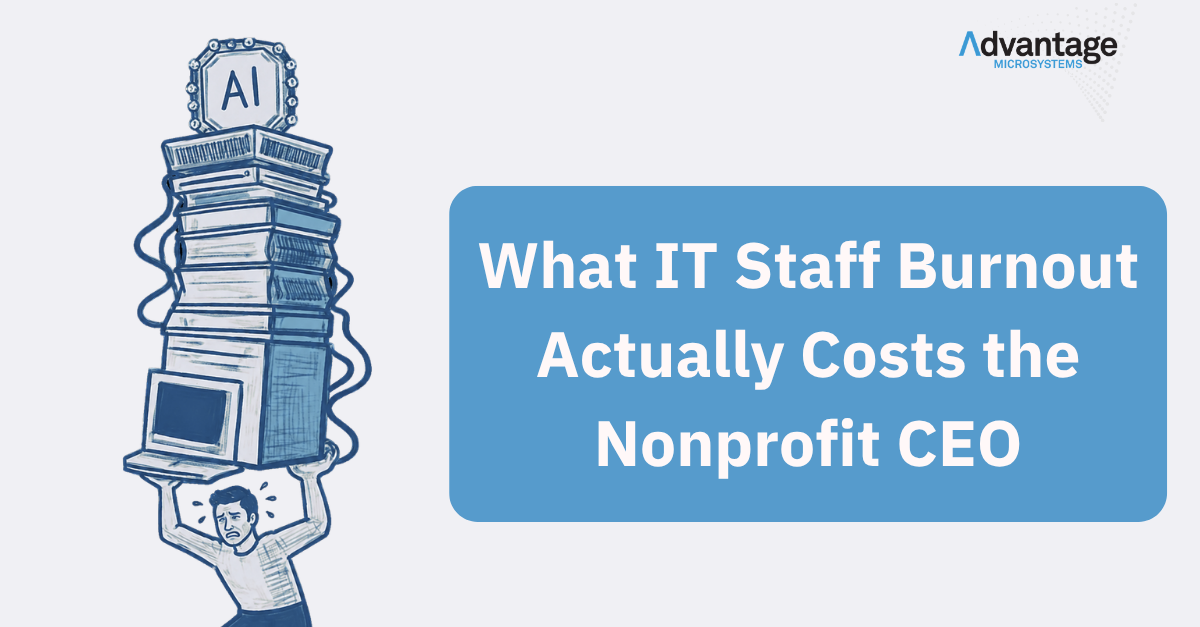
Somebody emails you on a Tuesday asking if the organization is “doing anything about AI.” You don’t have a clean answer. You have a hunch that whatever’s holding your systems together is thinner than it looks, and a board meeting in three weeks where that question is going to come up again, worded more formally.
That hunch is yours to carry, whether or not you have a dedicated IT person. If you do, you’re one resignation letter away from finding out how much you didn’t know you depended on them. If you don’t, every AI tool a program manager quietly starts using is a decision nobody signed off on, and you’re the one who’ll answer for it later.
The Job Got Bigger. Nobody Told the Budget.
Ten years ago, keeping a nonprofit’s network running meant fixing printers and making sure the internet didn’t drop during intake hours. That’s not the job anymore, and if you’re the one ultimately accountable for it, it’s not really a job you can delegate away and stop thinking about.
Cybersecurity requirements didn’t shrink. State and county reporting didn’t get simpler. Staff expect to work from a laptop at home, a phone in a parking lot, a tablet in the field. And AI showed up in the middle of all of it: a new category of exposure that lands on your desk whether you asked for it or not, because somebody in your building is already using it, right now, on data your organization is responsible for.
Executives are naming this strain directly, and it’s worth sitting with the source. IBM’s “5 trends for 2026” research found 56% say employees are getting burned out by responsibilities that keep shifting under them.¹ That’s a global survey of enterprise executives with entire departments behind them. You’re absorbing the same shift with a fraction of that support, and the accountability doesn’t scale down just because the headcount is smaller.
What This Actually Costs You
It rarely shows up as a single crisis. It shows up as a security update you keep meaning to ask about, a login system nobody’s fully mapped, a donor database connected to your accounting software in a way exactly one person understands. And you’re not entirely sure who that person is anymore, or whether it’s still true.
Here’s what it costs when the gap surfaces. If you have internal IT and that person leaves, you don’t just lose a role. You lose every undocumented workaround, every quirk, every “oh, that’s just how it’s always worked” fix that kept things running, and you find out how much of it existed only in one person’s head, usually during a week when something’s already broken. Vendors get called in at premium, emergency rates. New hires spend months relearning what walked out the door.
If you don’t have internal IT, the exposure looks different but lands on you just the same. Nobody’s watching for the AI tool a case manager started using last month. Nobody’s writing the policy that says what’s allowed and what isn’t. You find out about the gap when a board member asks, or worse, when something goes wrong and the answer to “who was responsible for catching this” is you.
Either way, the question a board member eventually asks isn’t really about IT. It’s about whether you knew, and what you did about it.
Why Adding One More Person Rarely Closes the Gap
The instinct is to hire your way out of it. For most organizations with 20 to 150 employees, a second full-time IT hire, let alone something closer to a fractional or virtual CIO, doesn’t fit a program budget built around grants and donor restrictions. And even when it technically fits, one hire still has to cover ground that keeps expanding on its own: security architecture, compliance documentation, AI governance, disaster recovery planning. That’s a lot of depth to ask of one generalist.
The coverage gap isn’t a hiring problem. It’s structural, and it’s still yours to close.
What Co-Managed IT Changes for You
Co-managed IT isn’t outsourcing your problem to someone else’s inbox. It’s addition: coverage for exactly the specialized weight that’s expanding fastest and that no one internal person, including you, has bandwidth to own alone. Security monitoring, compliance frameworks, vendor management, and the AI policy almost no nonprofit has had time to write from scratch.
That last piece deserves a closer look. Microsoft’s security research found 80% of business leaders name data leakage through AI tools as a top concern, with 88% worried about attacks that manipulate AI systems into behaving in unintended ways.² Most of the organizations in that survey have a security team dedicated to watching for exactly that. Yours may not. The exposure doesn’t disappear just because nobody’s assigned to it.
What This Looked Like in Practice
A California behavioral health organization we partnered with came to us already underwater. Clinicians locked out of patient records for hours when the EHR crashed under peak load. New hire onboarding eating a full day or two of manual setup before someone could actually start their job. No functional backups, meaning a single hardware failure could have erased records permanently, and the person accountable for explaining that to the board would have been the CEO.
We didn’t hand them a bigger internal department. We built a phased plan: stabilize what was actively breaking, optimize what could be salvaged, then transform the rest. Backups went in first. Then mobile device management, so leadership could remotely lock or wipe a lost device, something they’ve needed more than once since. Onboarding dropped from days to about an hour per batch. Logins scattered across a dozen systems consolidated into one secure sign-on.
Their CEO put it this way:
“Advantage Microsystems understands our mission and our operation and actively contributes to it. Everyone on the team is hands-on and proactive and feels like a partner, not a vendor. They provide the knowledge, tools, and support we need to operate efficiently so we can focus on caring for our clients and our community.”
One Question for Your Next Leadership Meeting
You don’t need to restructure anything by Friday. You need one honest answer, and it’s yours to give, not your IT person’s: if something broke tomorrow, a person, a system, a login nobody’s mapped, how much would you personally be on the hook to explain, and how fast could you actually recover?
If that answer is uncomfortable, that’s not a failure. It’s the exact starting point every leader we’ve worked with started from.
We’re covering this in more depth: what’s actually landing on nonprofit and behavioral health leaders as AI adoption accelerates, and how co-managed IT closes the gap without adding headcount, in a live session built for exactly this. Register for AI Is Now Your Problem: What Every Nonprofit CEO Should Know Before Their Team Breaks [Webinar Registration Link], take our nonprofit IT assessment, or book a capacity consultation to talk through where your organization stands right now.
¹ Source: IBM Institute for Business Value, “5 trends for 2026: Capture fleeting opportunities with confidence” (December 2025). Figures reflect a global survey of 1,028 enterprise C-suite executives across 20 industries, median revenue approximately $9.2B. Directional context, not nonprofit-specific data.
² Source: Microsoft Security, “5 Generative AI Security Threats You Must Know About” (2025). Figures reflect Microsoft’s research among security and IT decision-makers.
Questions About AI Governance for Nonprofits: Answered by Advantage Microsystems
Co-managed IT pairs whatever internal capacity you already have, one person, a small team, or none at all, with an outside partner covering the specialized areas that keep expanding: cybersecurity, compliance, and AI policy. It matters to you directly because the accountability for a gap in any of those areas lands with leadership, not with whoever happens to be handling IT that week.
Yes, arguably more so. Without internal IT, nobody is actively watching for the AI tools staff are already using or writing the policy governing them. Co-managed IT fills that role directly instead of leaving it to accumulate until a board member asks about it.
It’s rarely one crisis. It’s the accumulation of security requirements, compliance reporting, and now AI oversight, landing on an organization that was never staffed or budgeted for that scope, and all of it ultimately traces back to leadership when something goes wrong.
The role is the easy part to replace. What’s harder to recover is everything that person carried that was never written down — how systems actually connect, which workaround fixes which problem. Expect emergency vendor rates in the short term and months of a new hire rebuilding that knowledge from scratch, while you’re the one explaining the gap to your board in the meantime.
A full-time additional hire, especially at a specialized or CIO level, is rarely realistic for organizations with 20 to 150 employees once salary, benefits, and training are factored in. Co-managed IT typically costs less while covering specialized ground a single generalist hire may not have deep expertise in.
Start with a complimentary capacity consultation, or register for our upcoming session, AI Is Now Your Problem: What Every Nonprofit CEO Should Know Before Their Team Breaks, to see how co-managed IT works for California nonprofits and behavioral health organizations.